

 back
back
Analysis shows that Campus contributes £4.7bn to UK economy each year
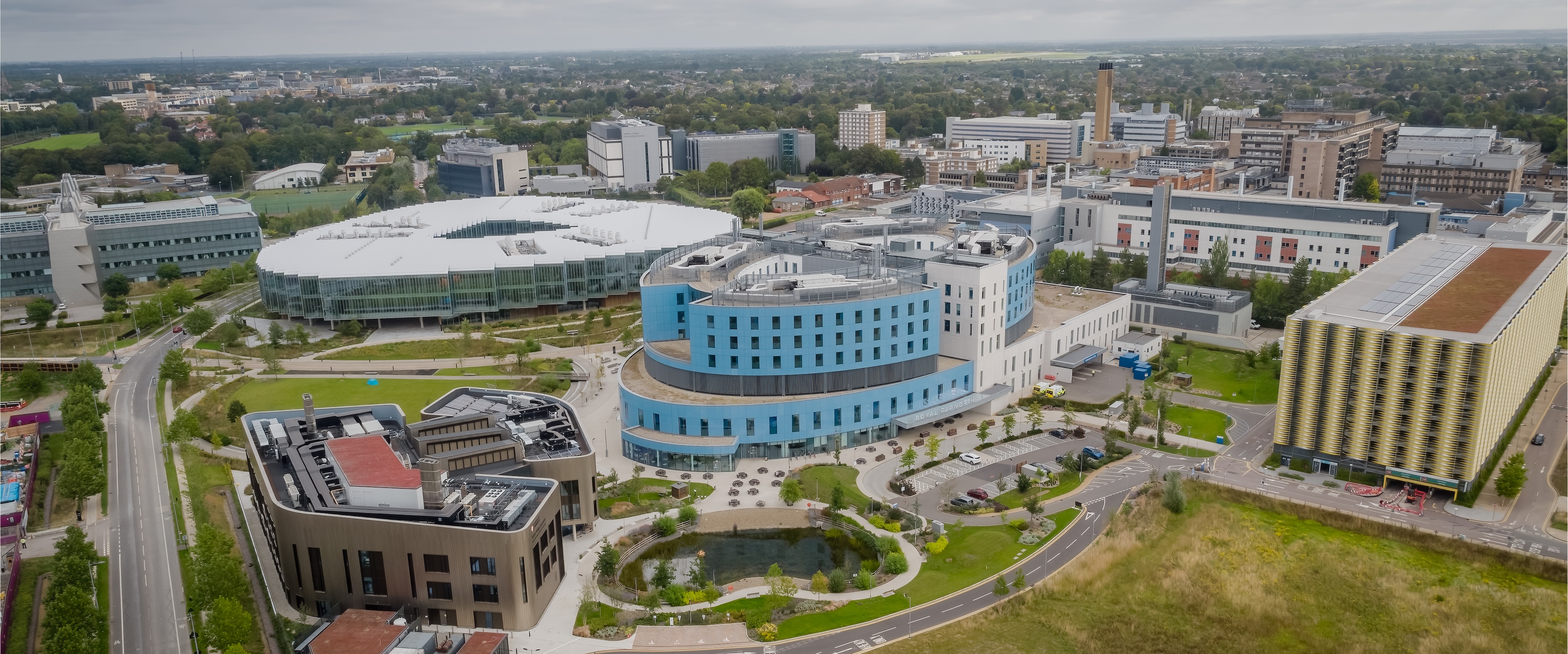
New figures show Campus’s impact on jobs and economic growth
In 2022, the Centre for Economic and Business Research (CEBR) produced a report on the economic impact of the Cambridge Biomedical Campus (CBC).
In 2025, CEBR was commissioned by CBC Ltd to update their analysis to reflect the current position and estimate the future growth based on plans for redevelopment and expansion. The CEBR analysis is in addition to the economic impact associated with healthcare services on the Campus, which were the focus of a report from Carnal Farrar, published in 2023.
What does the analysis show?
In 2025 the annual impact of CBC on the UK economy is £4.7bn GVA. Every £10 the campus creates generates a further £10 for the UK economy.
If the plans for redevelopment and expansion are progressed in line with the aspired 2024 Spatial Framework phasing and timing:
- The potential annual economic impact of CBC by 2035 is between £8.8bn and £10.7bn p.a. By 2050, it has the potential to increase to between £12.7bn and £18.2bn p.a.
- The cumulative value of the additional growth which could be achieved is estimated at £14.1bn by 2035, increasing to £121bn by 2050.
- This level of additional growth is of national strategic significance, equivalent to over 10 percent of the £78bn Ox-Cam Corridor ambition, as announced by the Chancellor in January 2025.
- The additional impact resulting from construction activities on the Campus further increases the economic impact. The total cumulative aggregate GVA attributed to construction activity on CBC by 2035 is £3.7bn, rising to a total cumulative value of £7.1bn by 2050.
Job creation
- Currently, 23,000 people work on the Campus, making it Cambridge’s largest employment site. That number has the potential to double in ten years.
- Furthermore, for every 10 direct full-time equivalent jobs generated by organisations on the Campus, a further 10.3 jobs are supported elsewhere in the UK economy.
- By 2035, CBC could support aggregate employment (includes those directly employed on the Campus, plus those additional jobs created in the wider UK economy as a result of Campus activity) across the UK economy between 77,213 and 91,882.
What is Gross Value Added (GVA)?
GVA represents the economic value created by a specific part of the economy, whether it’s a single company, an industry sector, or a region.
It’s calculated by subtracting the cost of intermediate goods and services (like raw materials and energy) from the total value of the output (goods and services produced).
What factors could affect future economic impact?
There are a range of risks which could serve to diminish and delay economic impact, including:
Expansion model: if expansion happens in a highly sequential manner without early delivery of infrastructure or is delayed for other reasons, the economic benefits are reduced. In a scenario where development is delayed by 5 years and then brought forward through a highly sequential approach to plot development, a total of £28bn GVA could be foregone by 2050.
Acute healthcare: without the necessary support to progress plans to redevelop acute healthcare on the campus, the overall GVA is reduced. Modelling indicates that a 5 year delay translates into foregone growth of almost £6.5bn GVA by 2050.
This is a once-in-a-generation moment to transform the Cambridge Biomedical Campus into a world-leading engine for healthcare innovation and UK economic growth. This vision won’t be realised without creating a truly holistic environment capable of attracting the very best global companies and talent – complete with the timely delivery of transport links, childcare, hotel and conference facilities and vibrant social hubs for collaboration – where academics, clinicians and industry researchers can come together to dream up the next generation of treatments and diagnostics that will transform everyone’s health.
Nick Kirby, Managing Director of Cambridge Biomedical Campus Limited